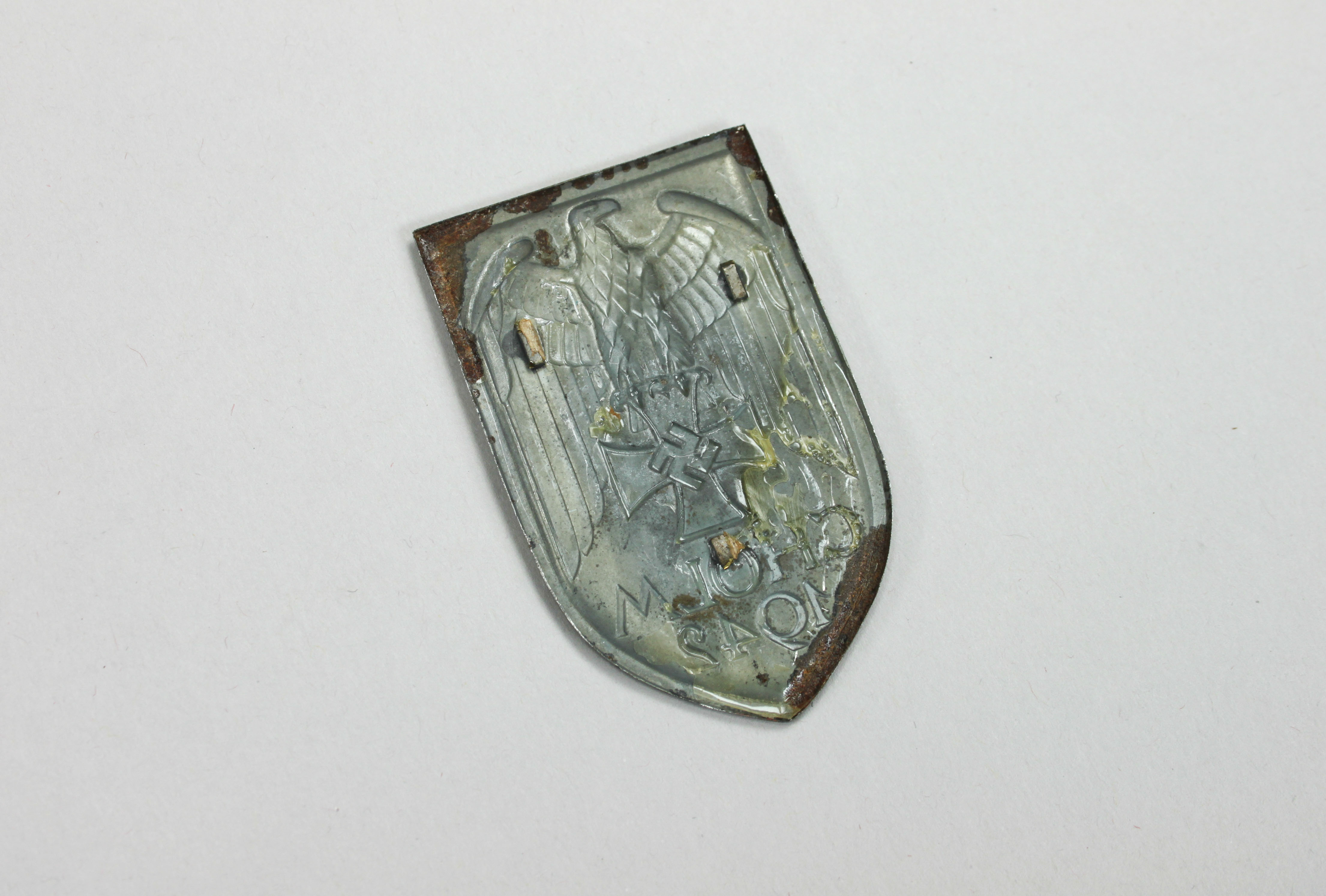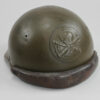
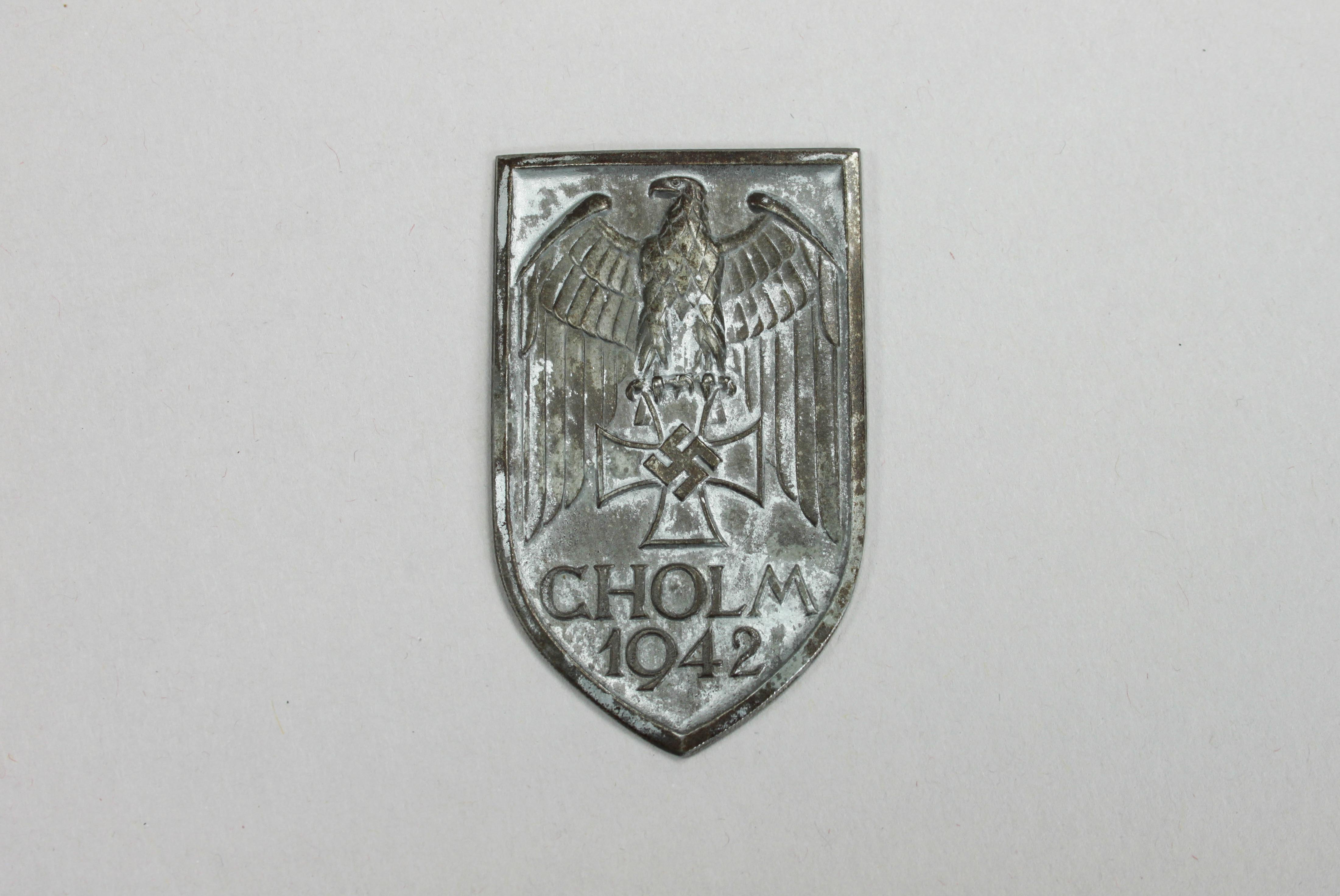
Cholm Shield, 1942

Inv. Nr.: DPM 3.2414

07/2026

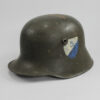
The German Tank Museum received this “Cholm Shield” in 1995 from a survivor of the Battle of Cholm—he survived the battle severely wounded and was likely the only survivor from his unit, Nahrichten-Abteilung 42. After World War II, he studied medicine and natural sciences and hung the badge in his office at the Bundeswehr Erprobungsstelle 53 for NBC Defence in Munster.

The Wehrmacht captured the small town of Cholm in the northwestern Soviet Union in August 1941. Because it was located at a transportation hub, the Wehrmacht used it to house rear area units and supply units, which is why members of various units and formations were in the town. With the onset of winter, the German advance came to a standstill. Since the surrounding bodies of water and marshlands had frozen over, the Red Army was able to advance—even with tanks—during a counteroffensive in January 1942 and encircled Cholm. The members of the encircled police and Wehrmacht units had only machine guns, anti-tank guns, and grenade launchers at their disposal and received artillery support from outside the city. They were supplied with food and ammunition by air.

The German troops, along with the few remaining residents, took shelter in the basements and ruins of the destroyed city. Approximately 1,550 Germans died in the fighting, from disease, and from the cold—temperatures dropped to below 40 degrees below zero. The number of civilian casualties is unknown. One survivor—whose police unit hanged a girl in Cholm and was responsible for numerous war crimes during the conflict—was a commercial artist who designed the Cholm shield during the fighting. In early May, German assault gun units broke through the encirclement and freed those trapped after 105 days. Two months later, the shield was officially approved as a military award, and approximately 5,500 people applied for it—either for themselves or posthumously for their relatives. Soldiers received up to five badges for their uniforms and coats and sewed the badge onto the left sleeve.

The German population did not learn of the siege until after the troops had been liberated from the encirclement.

Sources


Klink, Ernst: Heer und Kriegsmarine, in: Boog, Horst / Förster, Jürgen, Hoffmann, Joachim u.a.: Das Deutsche Reich und der Zweite Weltkrieg, Band 4: Der Angriff auf die Sowjetunion, Stuttgart 1987.

Muck, Richard: Kampfgruppe Scherer – 105 Tage eingeschlossen, Oldenburg 1943.

http://www.gelsenzentrum.de/polizeibatallion_65.htm
Object of the month

(short) stories from the depot

Unfortunately, many objects cannot currently be shown in the exhibition for conservation reasons. Here you will find unusual objects and exciting stories of special pieces from the depot